Work from the town’s instrument-making school, now taught through one-year certificates after its degree courses were withdrawn, will hang alongside paintings of Newark Castle at the National Civil War Centre until July 2027.
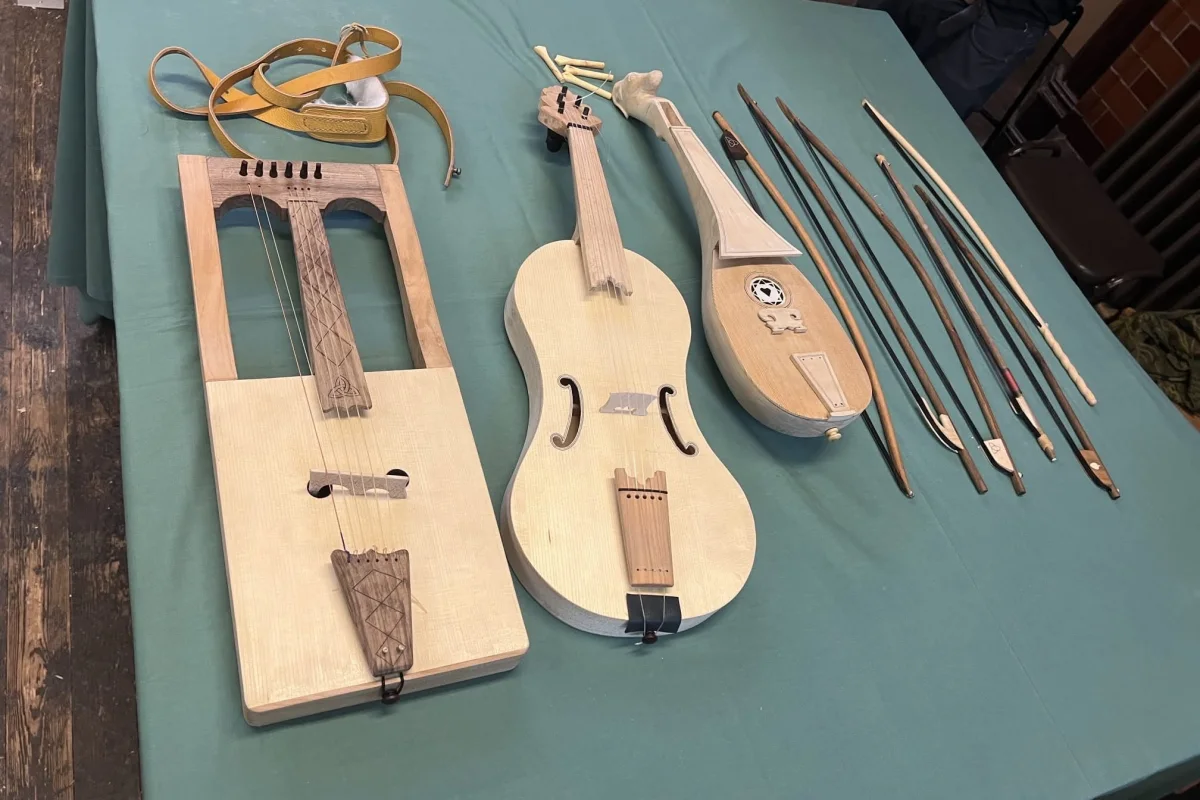
Instruments made by students at Newark College’s School of Musical Instrument Crafts have gone on public display in Living Landmark: Newark Castle in Art, an exhibition that opened at the National Civil War Centre, also known as Newark Museum, on Tuesday. The college announced the students’ inclusion on social media, saying it was “incredibly proud” to see their work shown in a celebration of the town’s heritage.
The instruments appear in an exhibition about how artists have recorded the castle. The show brings together paintings, drawings, prints and photographs across two galleries, tracing the castle’s history and its changing place in Newark’s cultural life. Works come from the National Civil War Centre and Newark Town Hall Museum and Art Gallery, supplemented by loans from museums elsewhere in the country. Among the loans is an oil painting of the castle by Alfred George Webster, lent by the Usher Gallery in Lincoln.
The college has not said how many instruments are on show, which students made them or how they relate to the castle theme. A district council preview of the exhibition, published by the Newark Advertiser on Monday, described the artworks and loans but did not mention the student pieces.
The display gives public exposure to a school whose future was uncertain only 18 months ago. In May 2025 the college said it would take no new students onto its Musical Instrument Craft degree courses for the 2025/26 academic year, because applications were too few for the courses to be financially viable. It replaced them with one-year courses in guitar, woodwind and violin making, alongside piano tuning and repair, costing £4,000 each. Because they are certificate courses rather than degrees, students cannot take out student loans to pay for them. The college said the new courses would give more time to workshop practice and drop many of the theory components and written assignments of the degrees.
The school has a long reputation in a small trade. Instrument crafts have been taught at Newark College since 1972, across four pathways: piano, violin, guitar and woodwind. The violin making and repair course has built a reputation over more than 50 years, and the college notes that fewer craftspeople worldwide are now training to do such work professionally. Its piano tuning degree was the only programme of its kind in the UK, and Steinway is among the firms that have recruited directly from the Newark Piano School.
The exhibition is the second recent collaboration between the college and the district’s museum service. Newark College supported the Robert Kiddey exhibition held across the National Civil War Centre and Newark Town Hall Museum from October 2025 to February 2026.
Rowan Cozens, deputy leader of Newark and Sherwood District Council and its portfolio holder for heritage, culture and the arts, said in the council’s announcement that the exhibition lets visitors see the landmark from different perspectives and learn how artists have recorded and interpreted it over time. He added that drawing on several collections would allow the museum to tell new stories about the castle while encouraging more people to visit. Admission to the museum is free for under-25s and for residents of Newark and Sherwood.
The exhibition coincides with the most extensive work on the castle in generations. The first phase of the Gatehouse Project, costing £8m and funded by the National Lottery Heritage Fund, the government’s Towns Fund and the district council, is due for completion in summer 2027. The gatehouse roof was completed in mid-September, making the building watertight for the first time in years, and a rooftop viewing platform is under construction.
The work has not been straightforward. In June the council’s cabinet was asked to approve up to £1.5m in extra spending after the discovery of a medieval wall and a well in the centre of the gatehouse, and after scaffolding revealed a large crack and badly deteriorated stonework in the chimney. In late September the East Midlands mayor, Claire Ward, committed a further £2.5m for a second phase that would open up the castle’s dungeons and underground spaces.
Living Landmark closes on 10 July 2027, around the time the restored gatehouse is expected to receive its first paying visitors. Entry to the gatehouse rooms and roof has been set at £9 for adults and £4.50 for adult residents of the district, with children admitted free and the grounds and gardens remaining free to all.