Around 3,000 households in Newark and Sherwood have begun receiving food waste caddies this week as the district council starts a six-month trial of weekly food waste collections, a year ahead of the date the service becomes mandatory across Nottinghamshire.
The trial covers parts of Southwell, Lowdham, and the Lincoln Road and Hawtonville areas of Newark. Caddies are being delivered from 12 October, and the first collections are due on Monday 26 October. Households outside the trial areas will see no change to their bin collections.
The pilot is the council’s rehearsal for a legal obligation. Under the government’s Simpler Recycling reforms, councils in England must collect food waste separately from households. Most were expected to do so from 31 March 2026, but Nottinghamshire’s district and borough councils agreed a transitional arrangement with the Department for Environment, Food and Rural Affairs that moves the county’s start date to October 2027, according to Nottinghamshire County Council. The council says the trial will produce data on participation rates, tonnages, vehicle performance and resident feedback before every household in the district is brought into the scheme.
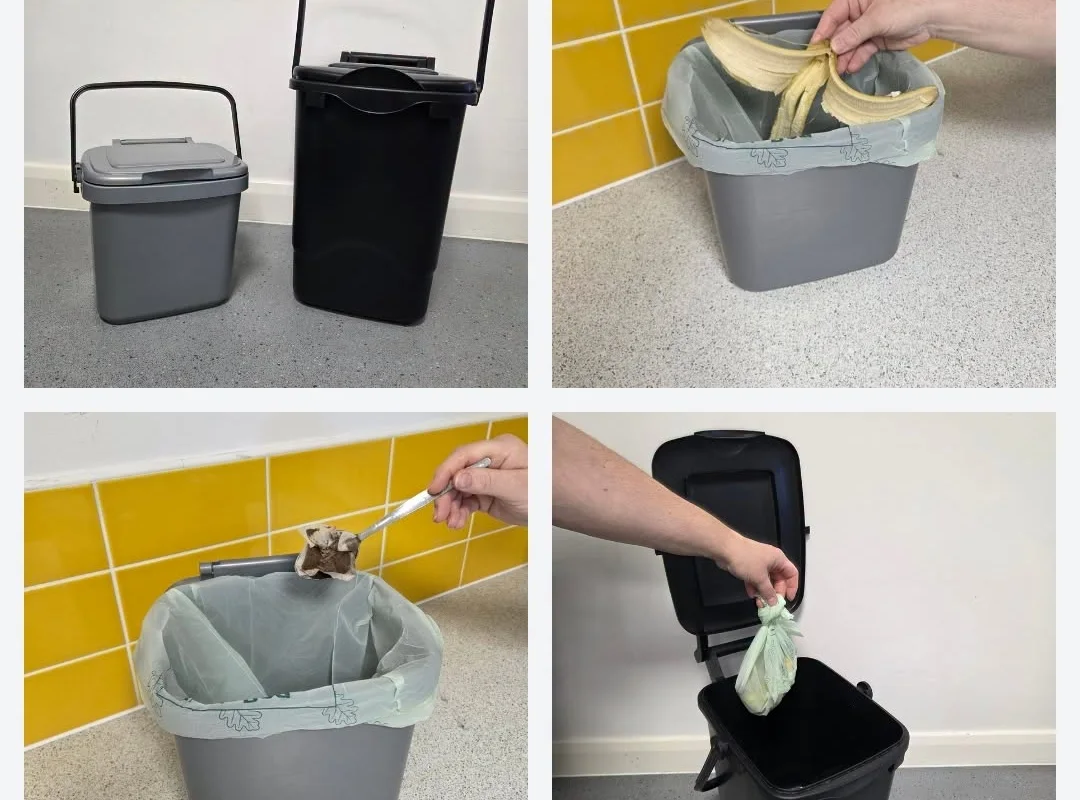
Each participating home receives a 7-litre kitchen caddy and a 23-litre outdoor caddy with a lockable lid. Residents fill the kitchen caddy, empty it into the outdoor bin and put that out on collection day. Accepted items include plate scrapings, raw and cooked meat and fish, bones, bread, rice, pasta, dairy, eggshells, tea bags and coffee grounds. Liquids such as milk, cooking oil and packaging are excluded.
One element of the trial is deliberately uneven. Some households have been given a starter roll of compostable liners and others have not, and the two groups will be collected on different days: Mondays for those with liners, Tuesdays for those without. The council says it is testing which approach works better before the wider rollout. Residents without liners have been told they can buy compostable ones or reuse bread bags, frozen food bags and small carrier bags.
A council report on the pilot, published in March, sets out some of its practical underpinnings. The caddies, around 3,300 outdoor and 3,200 kitchen units, are funded from the council’s food waste reserve, and collections are being run using the vehicle the council already operates for commercial food waste, on days when it would otherwise sit idle. The report also indicates that the council intends to keep collecting from trial households after the six months end, rather than withdrawing the service before the district-wide launch.
The timetable has moved since the scheme was announced. In April the council said the pilot would begin in September 2026 and described Newark and Sherwood as one of three Nottinghamshire authorities trialling the service. Its current guidance gives an October start and refers to one of only two.
Once collected, the food waste goes to a local anaerobic digestion plant, the council says, where it is broken down to produce biogas for energy and a fertiliser. Food that goes into the general waste bin, by contrast, is disposed of alongside other rubbish.
The council’s announcement on Facebook drew a cool response. Several commenters said they had no intention of taking part. One described the scheme as a waste of council tax money; another asked who would benefit from the energy generated. A resident raised the risk of rats, suggesting that plastic outdoor caddies could be chewed through, particularly in winter. Another argued that households could not afford to throw food away in the first place.
The council has anticipated some of those objections in its published guidance. It points out that food waste already goes into household bins, where it can sit for a fortnight between collections, and that the separate caddy will be emptied weekly and kept shut with a locking lid. It has not said whether participation in the trial is compulsory for the selected households, and the guidance is framed in terms of how to use the service rather than any requirement to do so.
How many households actually put their caddies out will be among the most closely watched figures from the pilot. The six-month trial runs into spring 2027, leaving the council roughly six months to adjust the service before weekly food waste collections reach every home in the district in October 2027.